01 / COMPARISON
Contact changes the movement.
Watch ARC, reflex-free control, and a top-down reflex respond to obstacles.
Humanoid robots in cluttered environments must react to contact before the first impact peak, which arrives within tens of milliseconds. A 50 Hz learned policy needs a full inference step to react, so the reflex must bypass it and act directly at the motors. Yet the robot still relies on the policy for balance and its task, and both act on the same joints. We propose ARC (Ascending Reflex Control), in which an instantaneous tactile reflex and a learned whole-body policy remain simultaneously in control.
ARC consists of two components: an instantaneous reflex pathway and bottom-up reflex integration. The reflex pathway detects hazardous contacts from full-body tactile sensing, solves a whole-body withdrawal pose, and delivers it directly to the motors within 10 ms. Bottom-up reflex integration combines reflex-in-the-loop policy learning, reflex-transparent policy alignment, and reflex-informed policy adaptation to sustain the withdrawal, maintain balance, and complete longer-horizon recovery.
We deploy ARC on a Unitree G1 and evaluate three categories of hazardous contact. Compared with an otherwise identical reflex delayed by 20 ms, ARC reduces the first force peak by 34.1% and reduces the contact impulse from 0.2632 N·s to 0.1225 N·s (a 2.15× ratio). We further demonstrate protected motion tracking, teleoperation, and vision-free obstacle traversal guided by foot tactile sensing.
Touch to motor response
Lower first force peak
Lower contact impulse
From a touch on the wrist to a step over an obstacle.
Explore ReflexArc on hardware.
Contact at the hands, arms, torso, and knee triggers local withdrawal and a coordinated retreat away from the collision.
01 — 04Touch reaches the motors through a direct reflex pathway. In the box-contact experiment, that timing reshapes the force of impact.
Synchronized hardware comparison · Includes 50× slow-motion replay
Lower first force peak
Lower contact impulse
Relative to the same reflex with 20 ms added delay.
Paper §V-A, Fig. 7.
Whole-body withdrawal begins at the skin.
Distributed tactile sensing locates contact at onset. A whole-body solver turns that signal into coordinated withdrawal, reaching the motors within 10 ms.
Flexible piezoresistive patches cover the wrists, elbows, knees, chest, back, and feet. Each 16 × 8 cm patch samples 128 taxels at 300 Hz. Per-taxel calibration registers the sensing surface in a digital twin, linking each reading to a body segment, position, and surface normal. Adaptive thresholds follow the noise baseline during nominal motion; a coherent rise across neighboring taxels identifies the first frame of contact. The active cluster’s centroid and surface normals provide the contact location and withdrawal direction within 5 ms of onset.
Using onboard proprioception and IMU measurements, the solver coordinates all 29 joints to withdraw from the contact. It chooses a terminal pose and applies the reflex offset . The objective combines local withdrawal, directional alignment, whole-body motion, center-of-mass motion, and regularization, subject to joint limits, fixed support frames, and self-collision clearance.
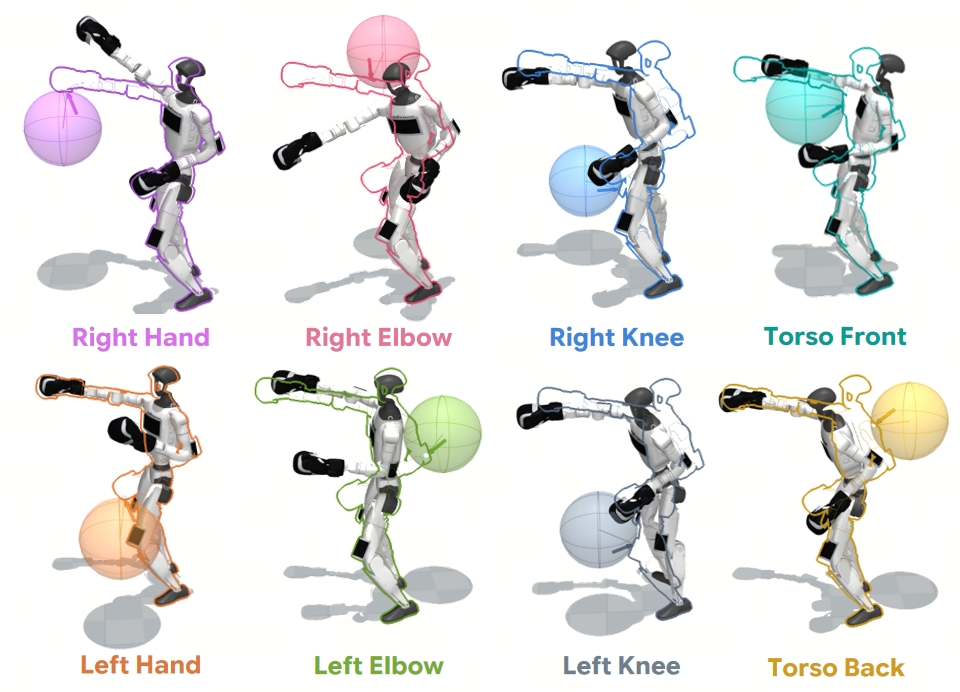
Inertia-weighted motion costs distribute the response across the body. Releasing the vertical CoM penalty allows a knee contact to elicit leg extension while retaining the horizontal motion cost. A short sequence of local quadratic programs refines the terminal pose, measuring motion from the same onset configuration at every round. The full onboard solve completes in under 4 ms; the learned policy maintains dynamic balance throughout withdrawal.
Learn to balance through reflexes.
Turn withdrawal into retreat.
Contact unfolds faster than the policy’s control cycle. ReflexArc sends a tactile-triggered withdrawal directly to the motors within 10 ms, while the learned policy continues to stabilize the body and pursue its task.
These two pathways command the same joints. Withdrawal displaces the robot from its tracking reference, so the policy can counteract it as tracking error. Ascending Reflex Control (ARC) brings reflexes into policy learning, aligns their observation and action interfaces, and lets contact guide a sustained retreat through the three designs below.
Withdrawal changes the robot’s posture and dynamics while balance remains the policy’s responsibility. ARC brings the low-level reflex into motion-tracking training, so the policy learns to stabilize the states that withdrawal creates. Its observations combine the tracking goal, proprioception, and tactile reflex information.
Each tactile patch contributes its activation, contact location and direction, and applied offset . During the reflex, the tracking target shifts to . ARC-Gym trains across 4,096 parallel environments by alternating tracking and reflex iterations: tracking collects collision states, batched LQP solves produce the corresponding reflexes, and reflex iterations restart from those states to train post-reflex stability.
The reflex spreads the robot’s states beyond the nominal tracking distribution. A policy trained on these transitions can still interpret withdrawal as tracking error and issue a counteracting correction. Reflex-transparent alignment keeps the observation and execution interfaces consistent with the policy’s tracking mapping.
ARC subtracts the reflex offset from observed joint positions and adds it back to the policy’s output joint targets. Because withdrawal also changes the dynamics, a DAgger-style objective supervises the policy against its reflex-free counterfactual output.
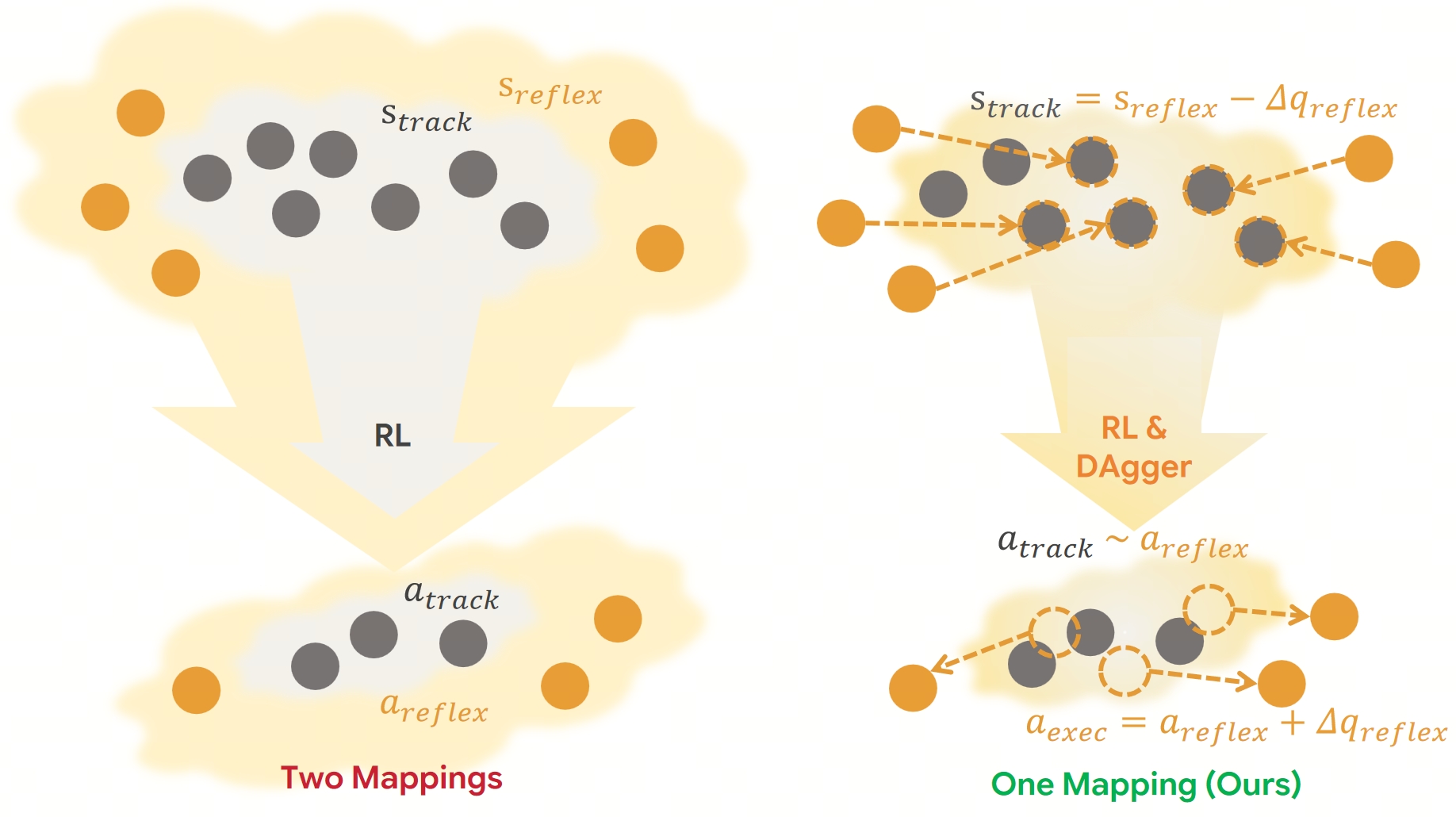
The shift acts on the joint-position component of ; is the counterfactual state reached with the reflex absent. Together, they place the policy in a world where the reflex never occurred, while the reflex keeps full authority in the real one.
The instantaneous reflex retracts the struck region within milliseconds. Moving the root away from the contact takes coordinated steps over seconds and often requires leaving the tracking reference. ARC’s contact-conditioned task reward guides the retreat direction and displacement, while an AMP prior learned from human repositioning motions shapes natural stepping during reflex-triggered recovery.
The objective combines tracking, contact-directed displacement, transparent alignment, and the human motion prior; marks an active reflex at patch . For step-over and stair climbing, the long-horizon task direction points forward, and corresponding human demonstrations shape the next step after foot withdrawal.
Hardware comparisons reveal the roles of reflex timing and behavioral adaptation.
Watch ARC, reflex-free control, and a top-down reflex respond to obstacles.
Explore the contribution of the reflex, adaptation, and human motion prior.
From local withdrawal through contact to global recovery. Five variants isolate the roles of training, alignment, adaptation, and the human motion prior.
| Method | Local withdrawal | Contact | Global recovery | ||||||||
|---|---|---|---|---|---|---|---|---|---|---|---|
| m/s ↑ | Holdcm ↑ | % | Surv.% ↑ | N·s ↓ | Rehit% ↓ | m | m/s ↑ | Dir. err.° ↓ | % ↑ | % ↑ | |
| w/o reflex-in-the-loop | 0.725 | 5.65 | 25.0 | 82.0 | 4.34 | 90.9 | −0.01 | 0.026 | 88.8 | 41.1 | 8.9 |
| w/o transparency | 0.900 | 6.74 | 29.7 | 99.2 | 4.22 | 58.3 | 1.67 | 0.475 | 12.0 | 100.0 | 57.3 |
| w/o adaptation | 0.919 | 7.03 | −8.7 | 77.3 | 3.63 | 88.0 | −0.01 | 0.021 | 88.9 | 42.2 | 6.8 |
| Explicit reference | 0.965 | 10.89 | −8.6 | 96.1 | 4.91 | 63.3 | 1.07 | 0.184 | 16.7 | 92.7 | 14.1 |
| Ours (ARC) | 0.971 | 11.06 | −9.1 | 99.2 | 3.42 | 59.4 | 1.70 | 0.426 | 11.5 | 99.5 | 63.0 |
Local withdrawal. Hold is mean withdrawal distance over 0.2–1 s. The compensation score is positive when the policy opposes the reflex and negative when it reinforces it.
Contact. Surv. is survival rate. integrates normal contact force over the first 100 ms. Rehit measures recontact with the same obstacle after separation.
Global recovery. Root displacement at 3 s, mean velocity along the commanded recovery direction over 0.2–1 s, direction error, and fractions reaching 0.5 m / 1.5 m at 3 s.
Explicit reference. Replaces the AMP reward with direct tracking of a retreat motion.
w/o transparency. Some recovery metrics look slightly better, but the policy cancels the reflex ( = 29.7, Hold 6.74 cm): recovery without withdrawal is a false success.
Play with the trained ReflexArc policy
in this interactive demo.
% BibTeX coming soon.